
From Idea to MVP: A Step-by-Step Guide for Non-Technical Founders
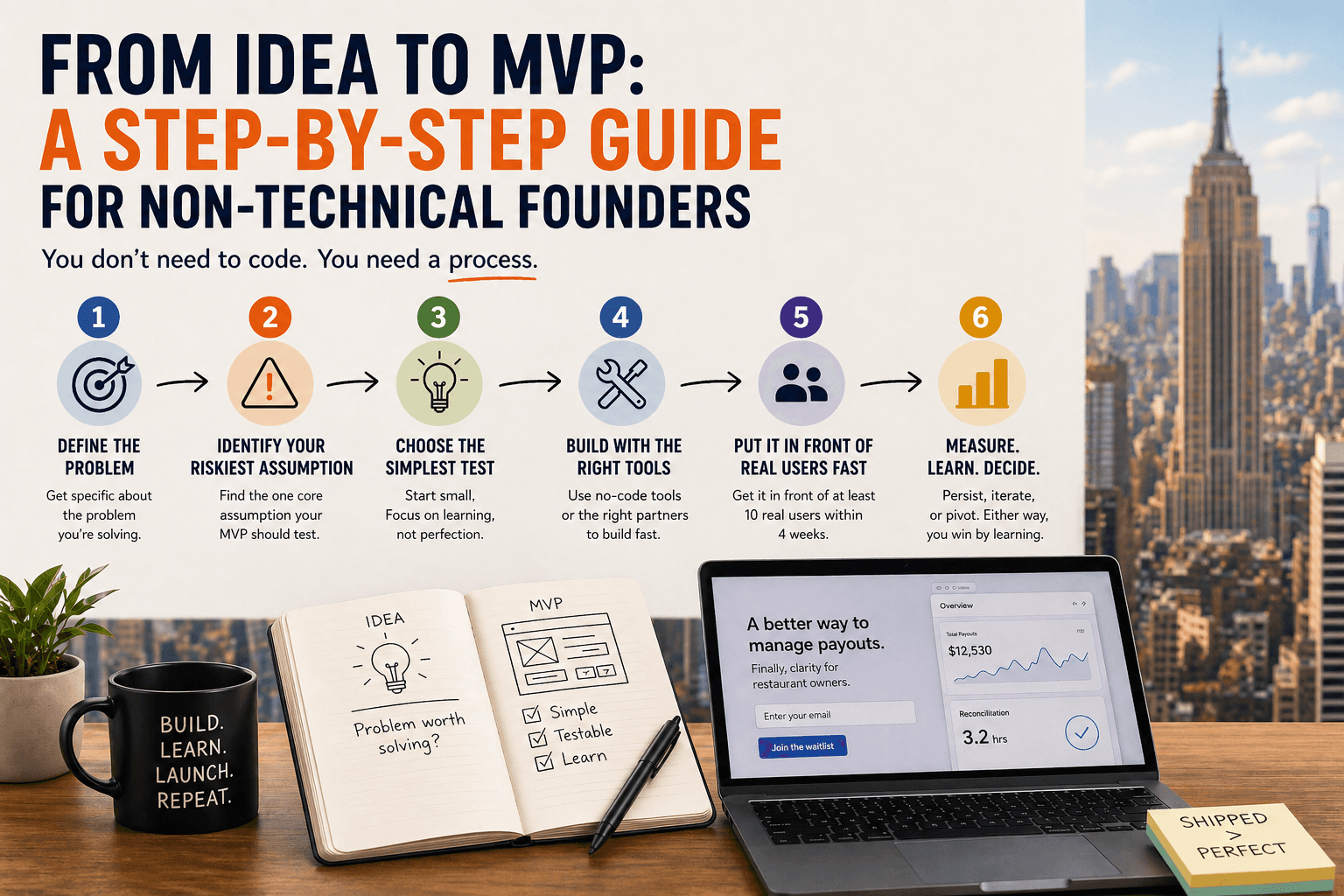
Every great product started as a messy, half-formed idea in someone's head. The founders who succeed aren't the ones with the best ideas — they're the ones who figure out how to test them cheaply and quickly. That process is called building an MVP (Minimum Viable Product), and it's the most important skill a first-time founder can develop.
At Centaur Lab, a venture studio in New York City designed for non-technical founders, helping people go from idea to MVP is at the core of what we do every day.
Step 1: Define the Problem with Precision
Before you build anything, you need to be ruthlessly specific about the problem you're solving. Avoid vague statements like "I want to make small businesses more efficient." Instead, aim for something like: "Independent restaurant owners spend 3+ hours per week manually reconciling delivery app payouts — leading to cash flow blind spots."
The sharper your problem statement, the easier every decision after it becomes.
Step 2: Identify Your Riskiest Assumption
Ask yourself: What would have to be true for this business to work? Usually, there's one core assumption that everything else depends on. That's what your MVP should test — not a full product, just proof that the core assumption holds.
Examples of core assumptions:
People will pay for this
Users will change their existing behavior
The unit economics are viable at scale
Step 3: Choose the Simplest Test
Your first "product" doesn't need to be software at all. Some of the best MVPs have been:
A landing page that describes the product and collects email signups
A concierge MVP where you manually deliver the service before automating it
A Figma prototype you click through with real users
A simple form + spreadsheet backend
Don't over-engineer. The goal is learning, not perfection.
Step 4: Build With the Right Tools
If you do need something interactive, today's no-code and low-code tools are remarkably powerful:
Framer / Webflow — for marketing sites and simple apps
Bubble — for more complex web applications
Glide / Softr — for mobile and internal tools
Zapier / Make — for connecting everything together
Or partner with a studio like Centaur Lab, which provides the technical team so you can stay focused on customers and strategy.
Step 5: Put It in Front of Real Users Fast
This step is where most founders stall. They polish endlessly instead of shipping. Set a deadline: your MVP should be in front of at least 10 real potential users within 4 weeks of deciding to build it. Not friends. Not family. Real people who have the problem you're solving.
Step 6: Measure, Learn, Decide
After your first round of user feedback, you face three paths:
Persist — the assumption was right, keep building
Iterate — you're close, but something needs to change
Pivot — you learned something that changes the direction entirely
All three are wins. The only failure is building for months without talking to users.
The Centaur Lab Advantage
Centaur Lab exists because the founder journey shouldn't require a technical background to get off the ground. With the right support system, non-technical founders can move just as fast — sometimes faster — than their technical counterparts, because they stay closer to the customer.
About The Author
Centaur Lab is a New York City venture studio built for non-technical founders. We partner with you from idea to launch. Learn more at centaurlab.ai.